Loaded and out
Palletised and packaged goods, strapped down and away. Multi-drop rounds are where the forklift on the back pays for itself.
The forklift travels on the trailer. It comes off at your address, unloads the wagon and goes back on — so a palletised load reaches a site with no forklift, no loading bay and nobody waiting to receive it.
A Moffett is a forklift carried on the back of the trailer. The driver takes it off at the delivery, unloads the wagon with it, drives it back on and straps it down before moving off. Nothing has to be waiting for you at the other end.
That is the whole point of it. Most delivery problems are not about the journey, they are about the last thirty yards — a site with no forklift, a yard with nobody in it, a farm track, a half-built estate road. A wagon with a Moffett on the back solves that on its own.
It is not a crane and it does not pretend to be. If the load has to go up and over something, that is hiab work and we will tell you so.
The head on the front is not always plain forks either. A brick grab takes packs of bricks and blocks straight off the bed and sets them down flat, a pack at a time, so a load of masonry lands where the bricklayers want it. We can also move bricks by hiab with a brick grab — the same attachment on the end of the crane — for the packs that have to go over a wall, a fence or a scaffold rather than round one.
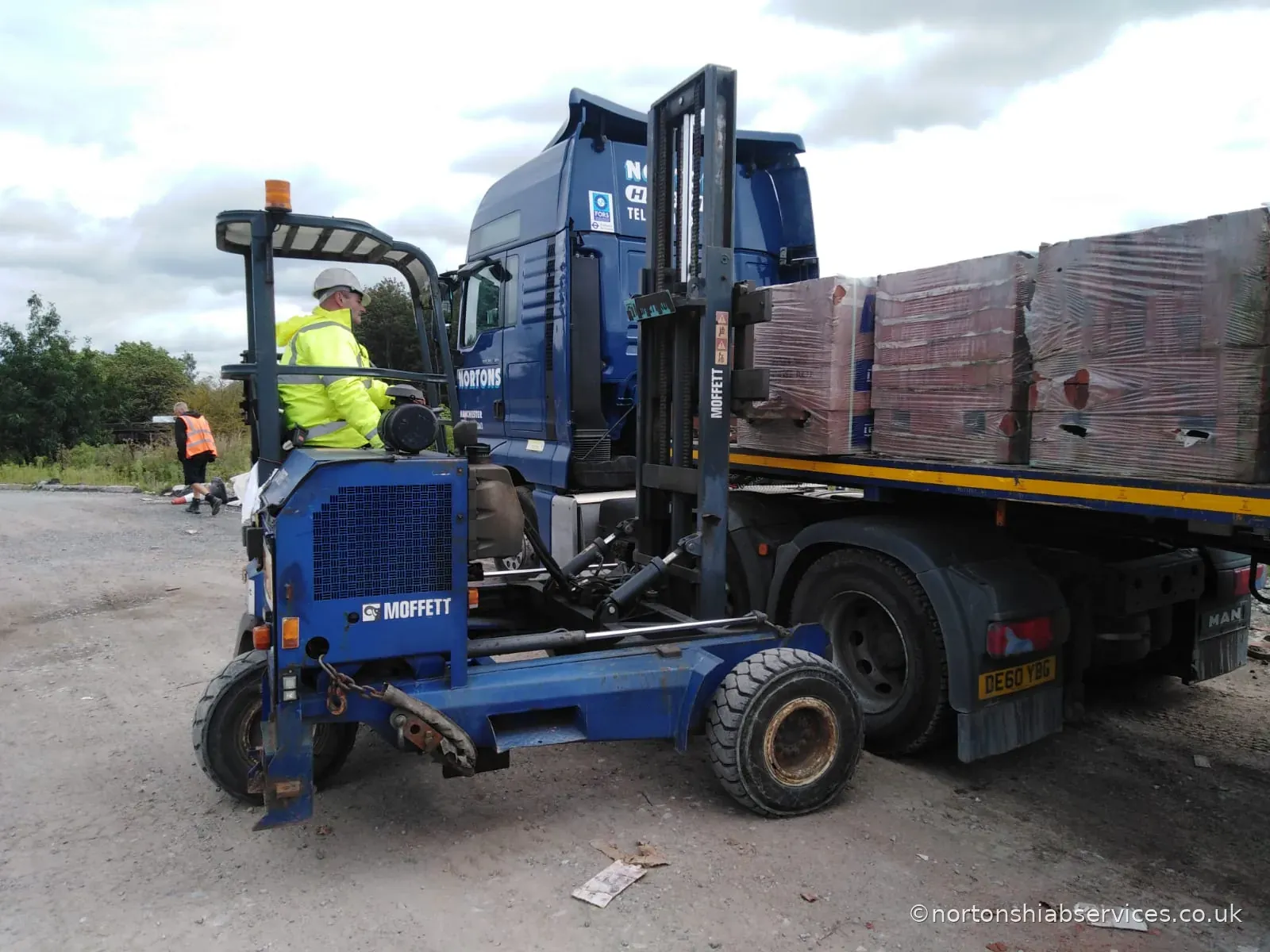
Palletised and packaged goods, strapped down and away. Multi-drop rounds are where the forklift on the back pays for itself.
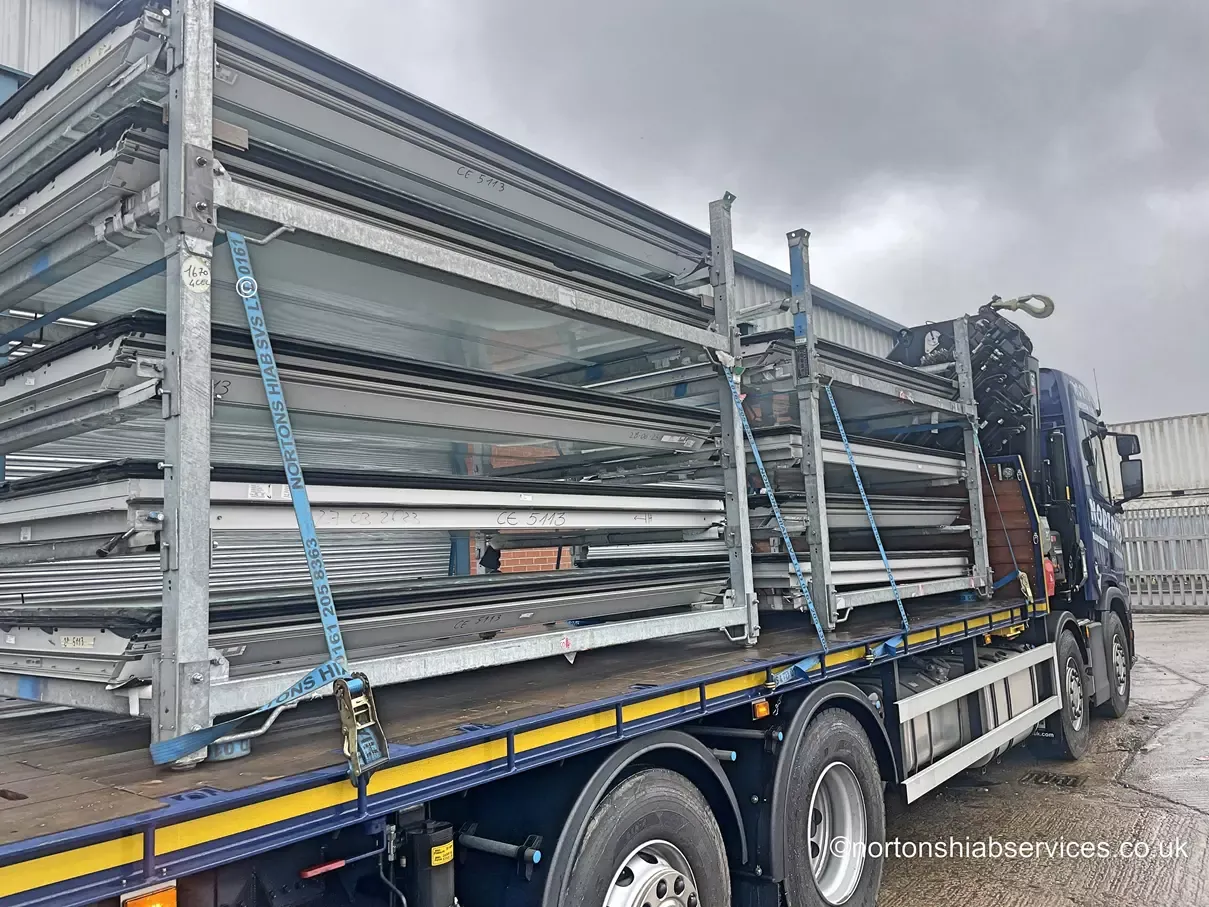
Glazing, frames, blocks, bagged materials, timber and roofing — the deliveries that turn up at sites with nothing to unload them.
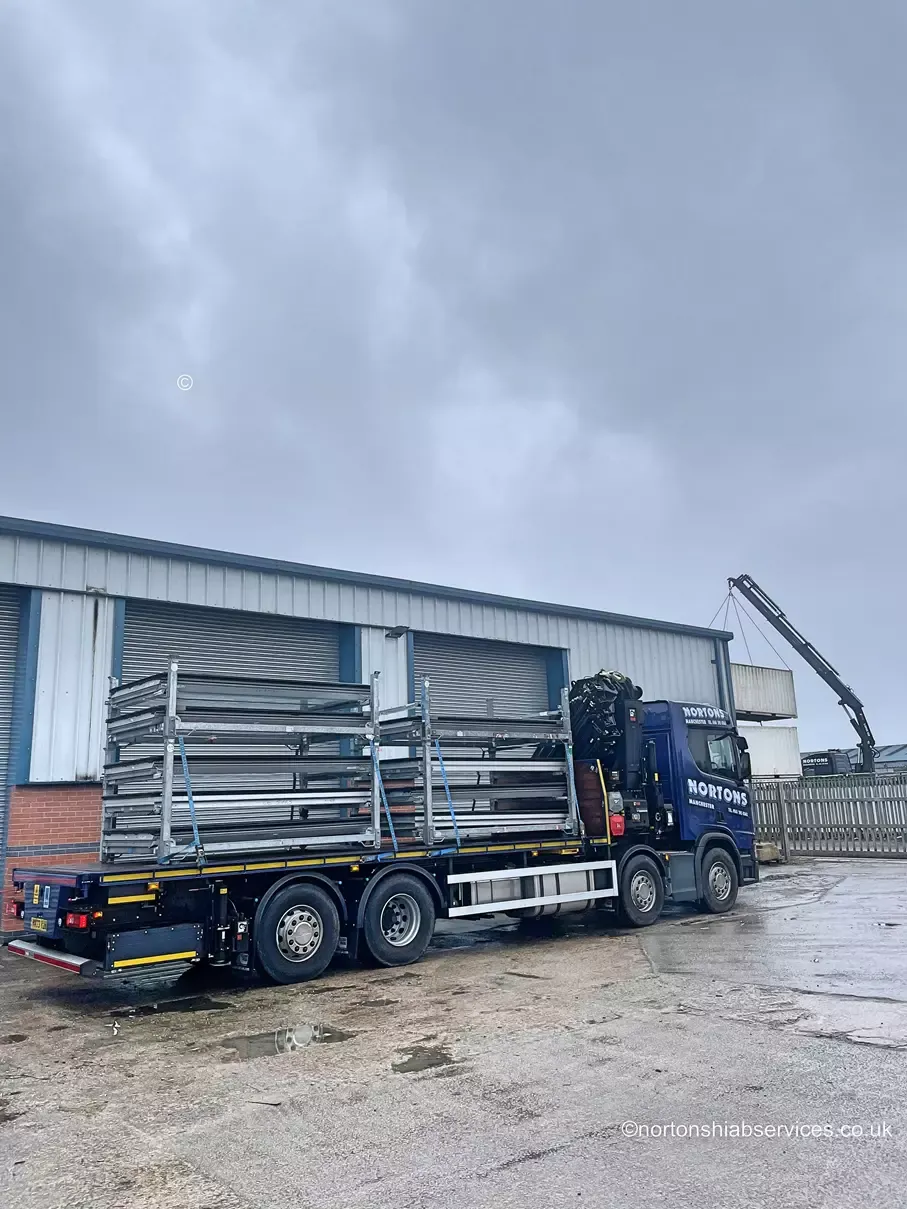
Nobody has to be waiting with a forklift. The driver unloads on his own and takes the machine away with him.
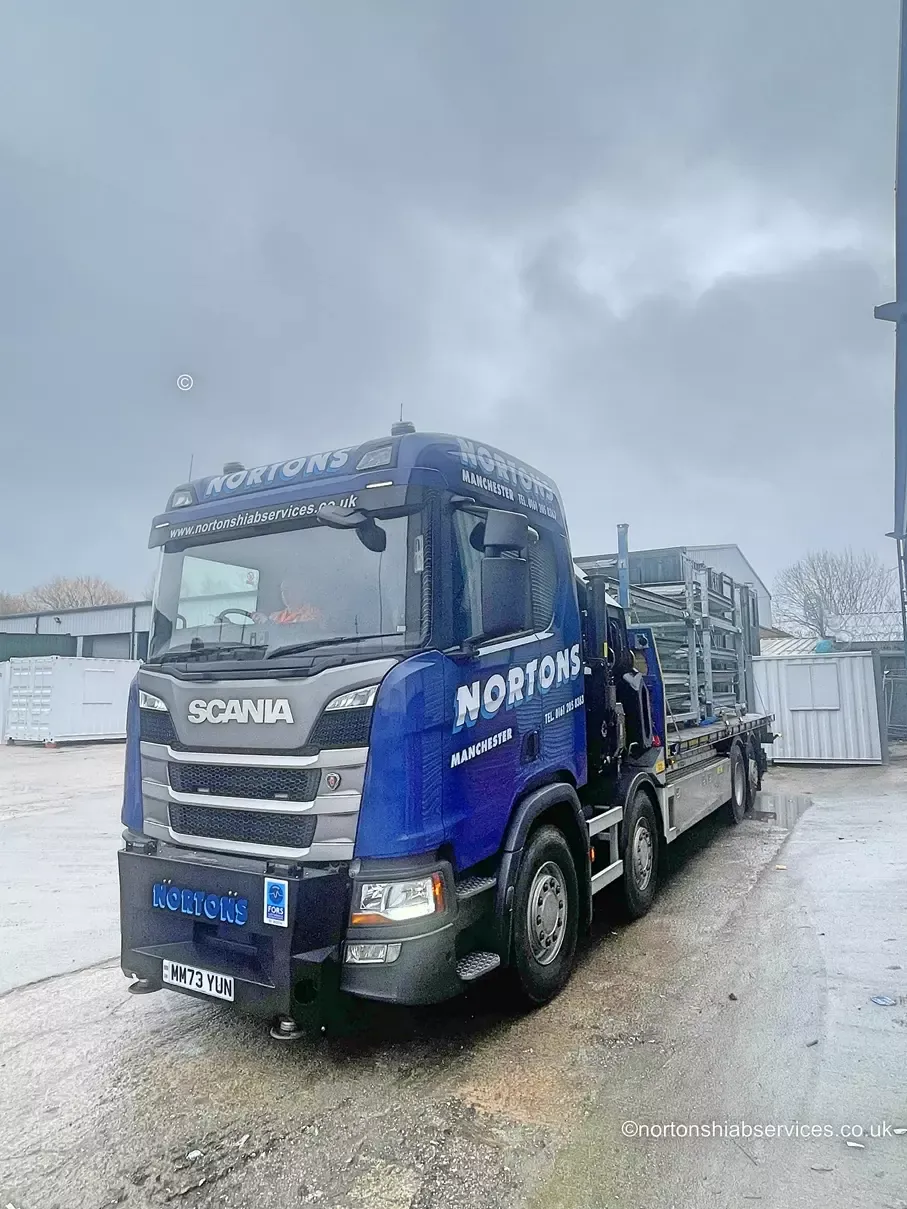
About these photographs. They show our flatbed and stillages delivery work.
The full vehicle and trailer list · Published crane load charts
We run both, so we have no reason to sell you the wrong one. This is the honest comparison.
| Moffett | Hiab crane | |
|---|---|---|
| Reach over an obstacle | None | Yes, that is what it is for |
| Puts the load | On the ground, where it can drive | Where the crane can reach |
| Best for | Pallets, packaged goods, multi-drop | Single heavy or awkward items |
| Rough or soft ground | Handles it | Needs firm footing for the legs |
| Site equipment needed | None | None |
| Costs you payload | Yes, it rides on the trailer | Yes, the crane is on the vehicle |
| Placing accuracy | Rough position | Onto a prepared base, to the inch |
If you are not sure, describe the last thirty yards rather than the load. Whether there is a wall, a hedge, a fence or a level change between where the wagon can stop and where the goods have to end up is the question that decides it — not the weight. There is a fuller explanation of the difference on what is a hiab.
We publish every return load we advertise, going back to 2015, exactly as it was written at the time. One of them is this, posted on 16 August 2016:
45ft flat with Moffett available in Peterborough first thing tomorrow morning.
Not a claim on a services page. A wagon, a date and a town, written down at the time by whoever was on the traffic desk that Tuesday. You can read the rest of that year on the 2016 archive and the whole decade from the back loads hub.
That last question is the one that changes the answer. If something has to go over a wall or into a first-floor opening it is not a Moffett job, and we will put a hiab and driver on it instead.
A Moffett is a forklift that travels on the back of the trailer rather than meeting it at the other end. The driver drops it off the rear of the trailer at the delivery, unloads the wagon with it, drives it back on and straps it down. It means a palletised load can be put on the ground at an address that has no forklift, no loading bay and nobody waiting.
Reach. A hiab is a crane on the vehicle, so it lifts up and over things — a wall, a hedge, a parked car, a first-floor opening. A Moffett has no reach at all. It picks a load up off the deck, carries it at ground level and sets it down where it can drive to. If the load has to go over an obstacle you need a hiab. If it just has to get from the kerb to round the back of the building across rough ground, the Moffett is quicker and cheaper.
Palletised and packaged goods going to sites with no unloading equipment. Building products, blocks, bagged materials, timber, fencing, roofing, plasterboard and similar. It is at its best on multi-drop work where the driver has to unload alone at several addresses in a day, and on soft or unmade ground where a pallet truck would sink.
Anything that has to be lifted over something, placed on a base or set down accurately, and anything that is one heavy indivisible item rather than a set of pallets. That is crane work. It is also wrong where the delivery point cannot be driven to at all — the Moffett needs a route from the trailer to the drop, even a rough one.
We confirm the rated capacity, fork length and mast height for your delivery rather than publishing a headline figure, because what decides it is the pallet weight and the ground between the wagon and the drop, not the number on a brochure. Tell us both and we will give you a straight answer before anything is booked.
Yes, and it is worth knowing before you book. The forklift rides on the trailer, so it costs you both weight and a little deck length. On a full 45 foot artic load that is rarely the deciding factor, but on a heavy load close to the plated weight it can be. Tell us the total tonnage and we will say whether it still fits.
Yes. Every Moffett movement is operated. The same driver runs the vehicle and the forklift, and is qualified for both. You do not need to supply anyone at your end.
We run from Manchester and work across mainland Great Britain. Moffett work tends to be regional simply because it suits multi-drop delivery rounds, but there is nothing stopping a single long-distance run if that is what the load needs.
What the load is and where the wagon can stop. We will tell you whether it is a Moffett job, a crane job, or neither.




ALLMI trained driver / operators · RAMS, method statements and lift plans · Euro VI clean air zone compliant fleet, renewed by continual investment in new wagons · All our accreditations