Statue and sculpture transport
Somebody has spent months making it and there is only one of it. Our part is to get it there without a mark on it and set it down exactly where it belongs, first time.
One vehicle, two lifts, no second attempt
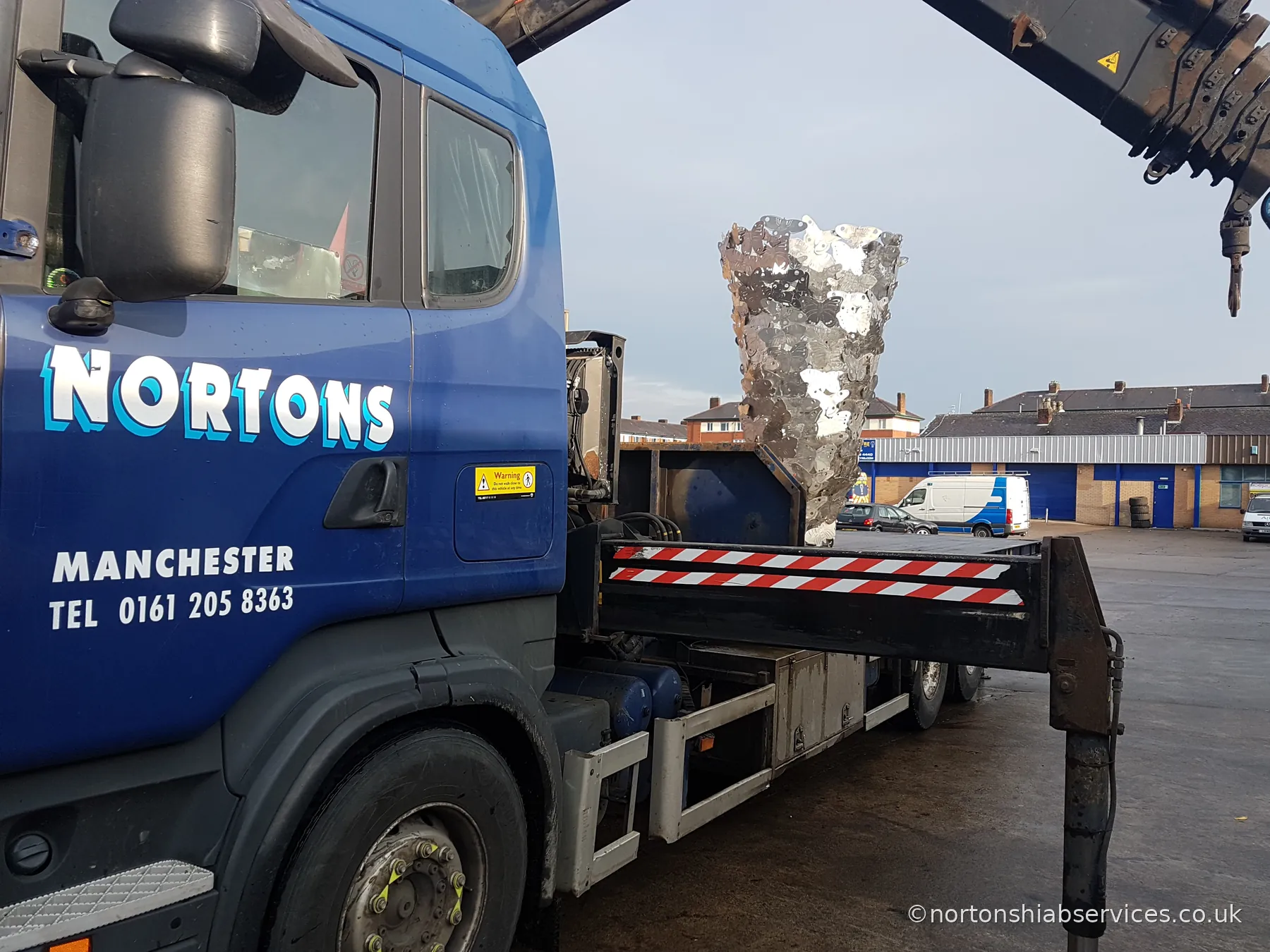
Nortons carries and installs statues, sculptures and public and private artwork on lorries that bring their own crane — loaded at the foundry, workshop or store, carried standing or laid down, and craned onto the plinth on arrival.
Almost everything about a sculpture argues for doing it that way. The piece is handled twice instead of four times. Nobody has to find somewhere to put it down while a crane is set up. And the people who slung it in the morning are the people who land it in the afternoon, which matters when the load has a right way up and a wrong one.
The weight is rarely the difficulty. Most pieces we move are well inside what any of our cranes will pick up. What decides the day is the shape, where the weight sits inside that shape, what the surface will tolerate being touched by, and how far the crane has to reach to put it where the drawing says.
Getting it there unmarked
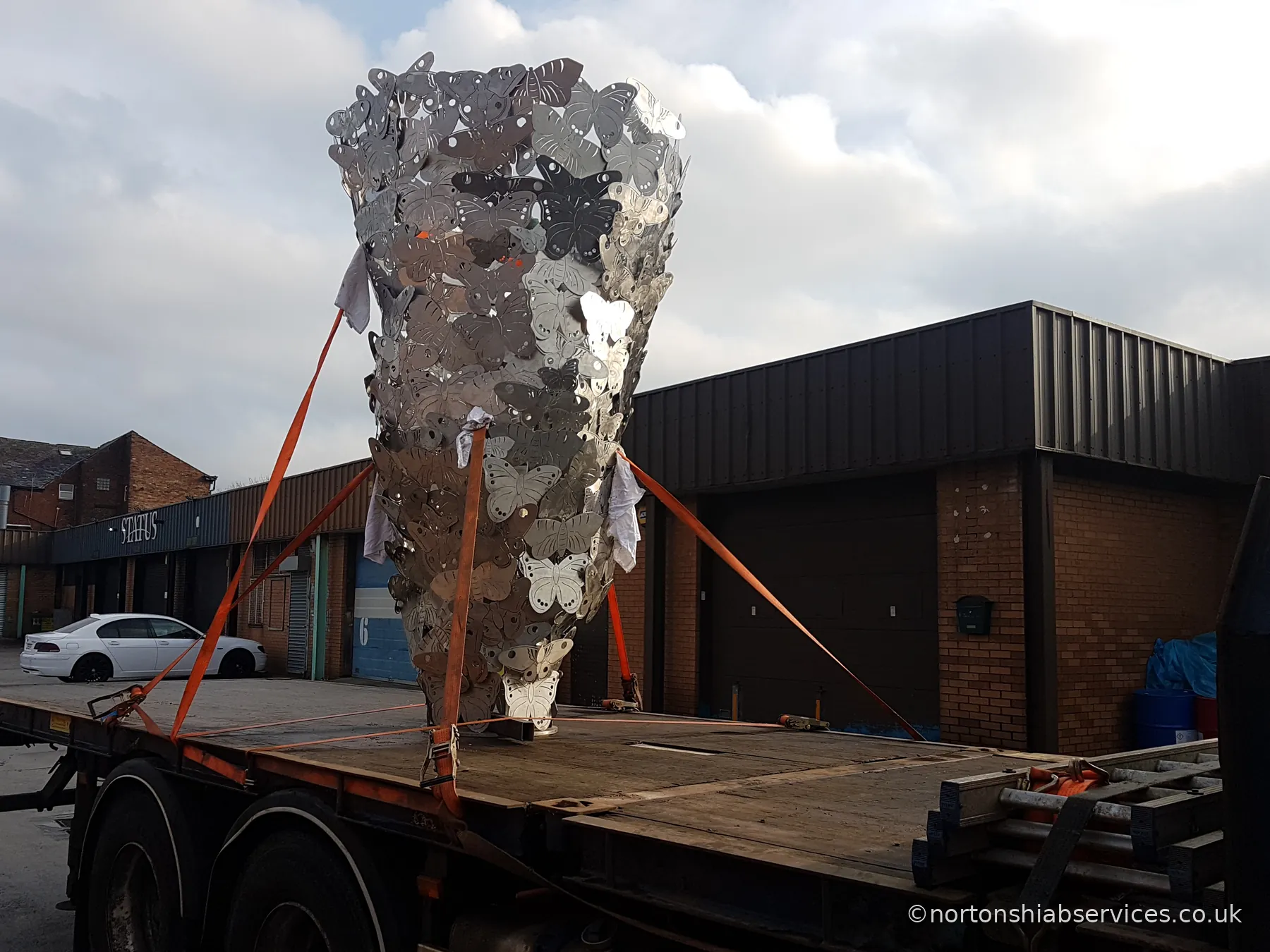
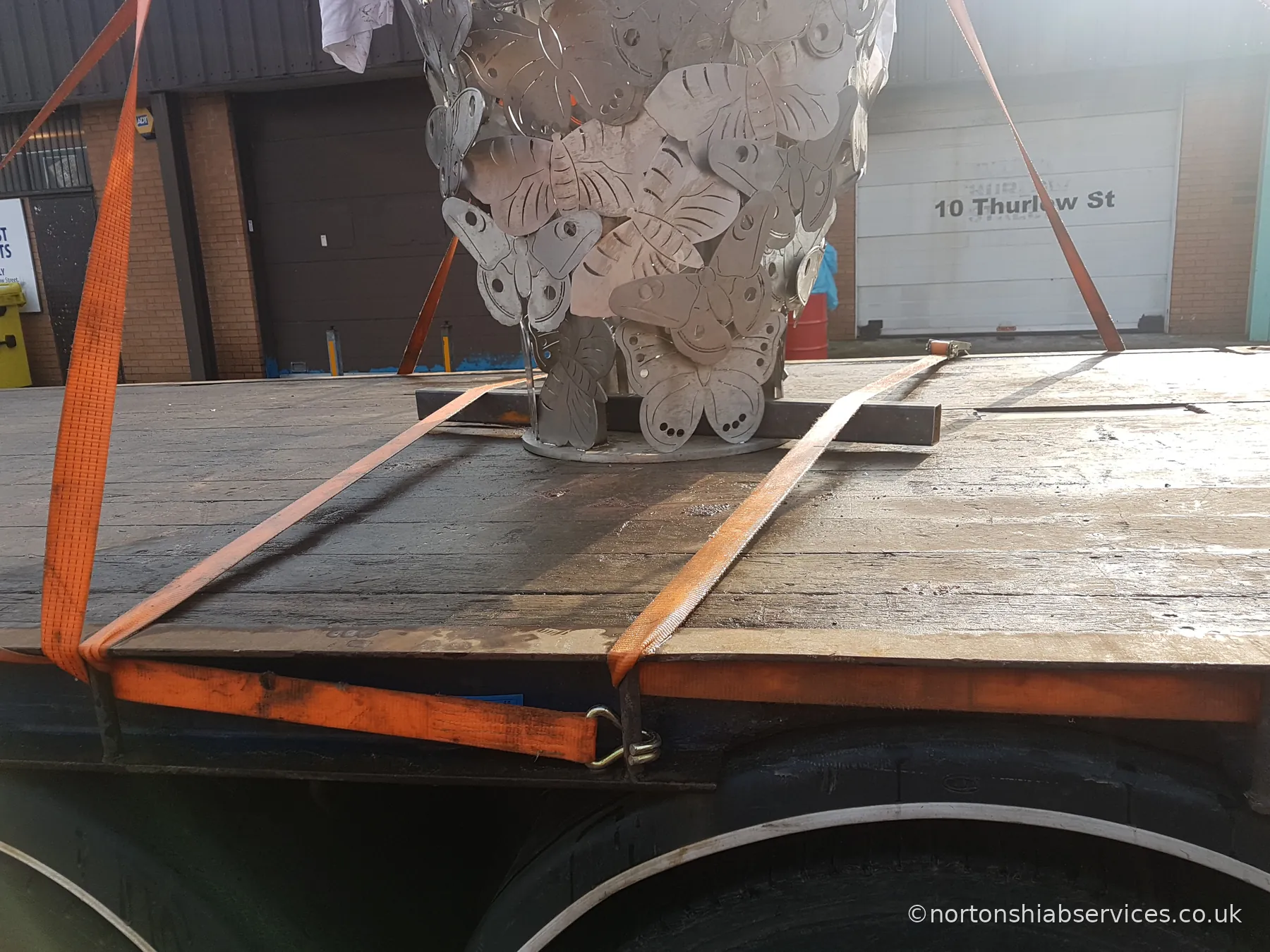
A sculpture is strapped to a framework rather than to itself. The base is boxed in with timber and steel so it cannot slide or tip, and the ratchets are taken down to that, not thrown over the artwork. Where webbing has to touch the piece it is soft-slung and padded, and where a straight pull would close a sling round something delicate a spreader beam goes on instead.
Tall pieces travel upright wherever the height allows it, because standing a sculpture back up on site is a second lift and a second chance to get it wrong. When one has to travel laid down, it is cradled to the shape rather than laid on a flat deck.
Where the straps actually go
This is the part that decides whether a sculpture arrives in the state it left in. The steel sections chocked against the base take the load, the straps pull down onto those, and nothing tightens against the work itself.
It takes longer to load than a container does, and it is the reason we would rather be told about a piece a week early than an hour early. Everything that touches it is worked out before the lorry leaves the yard.
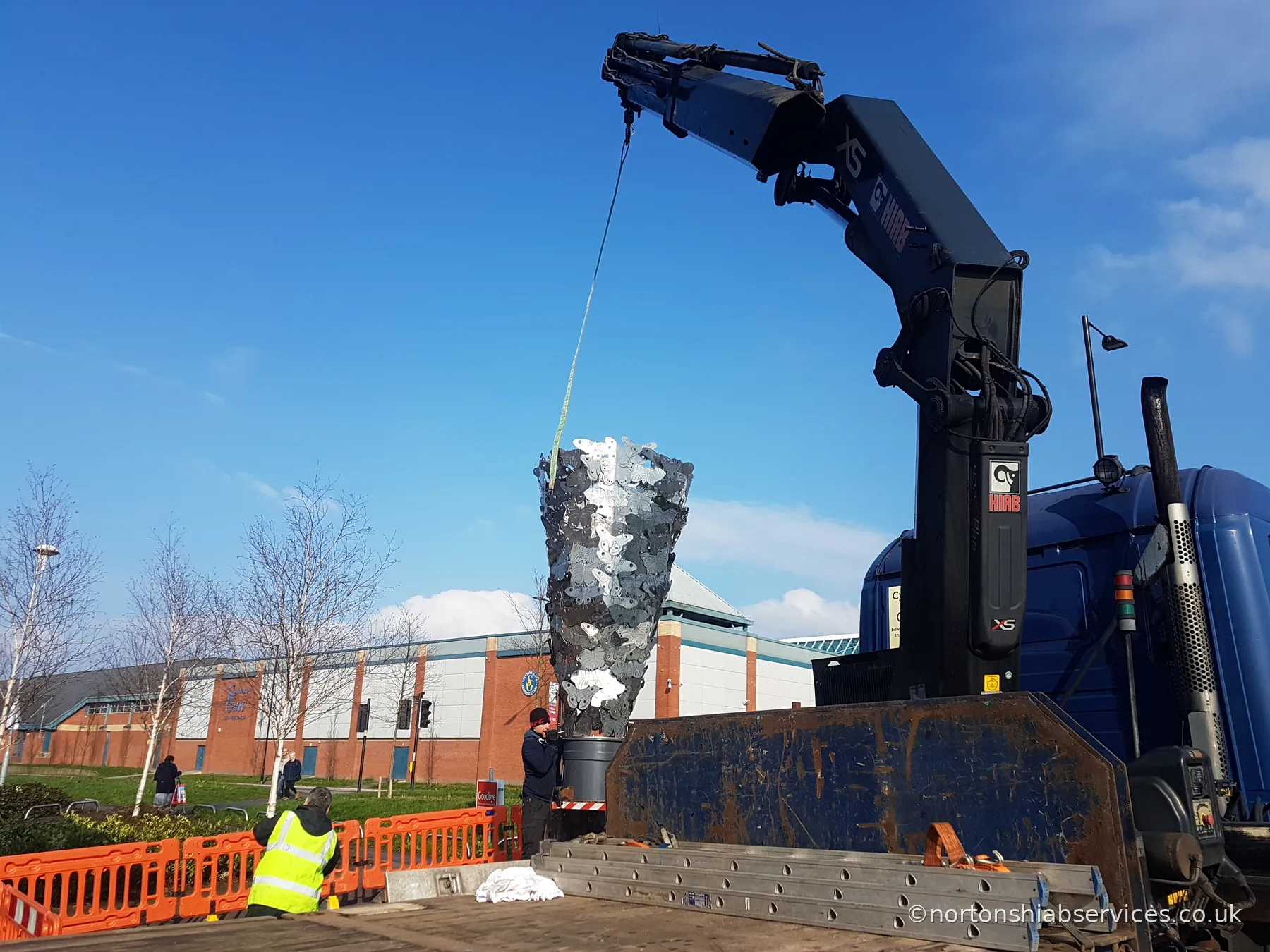
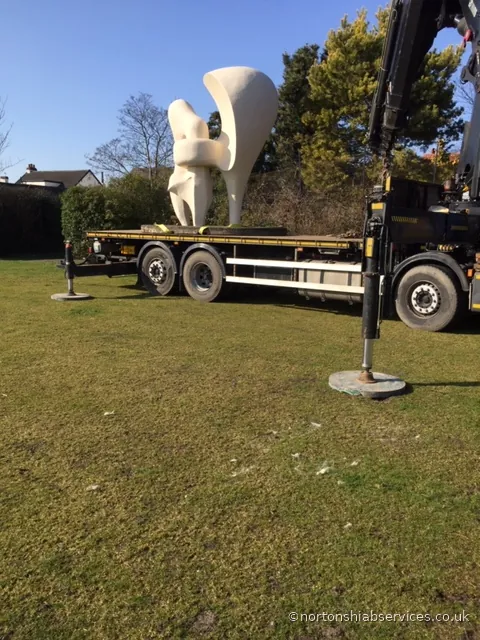
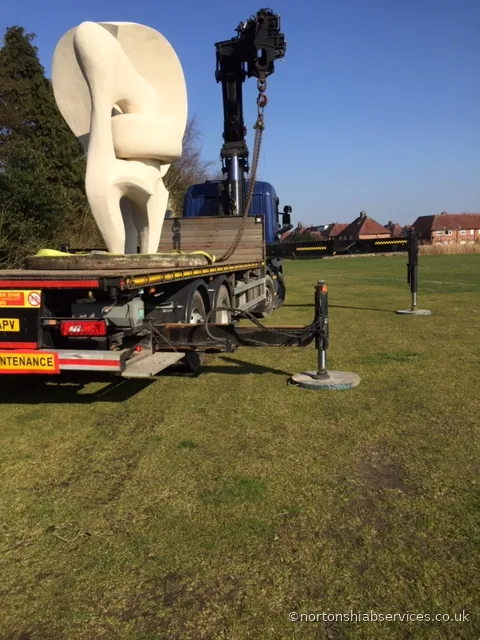
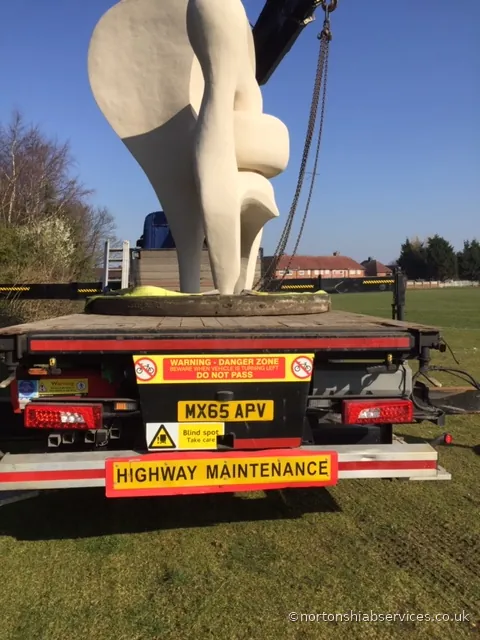
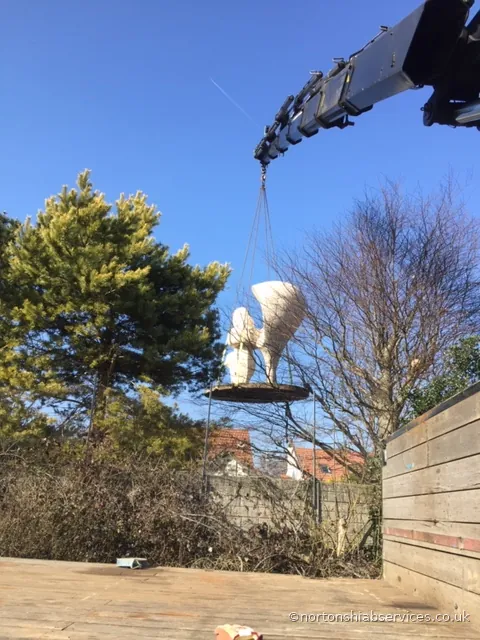
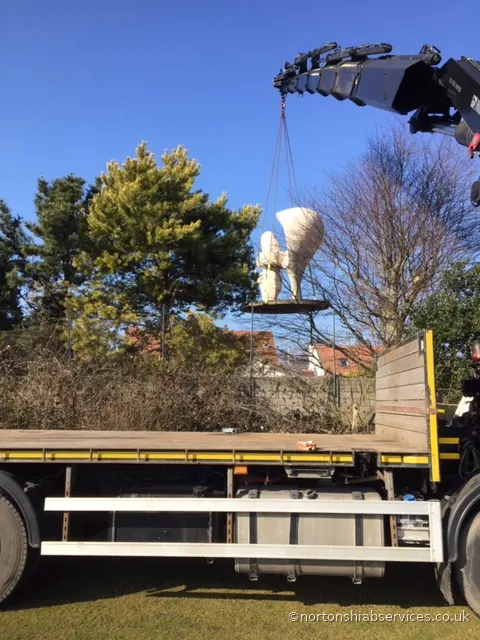
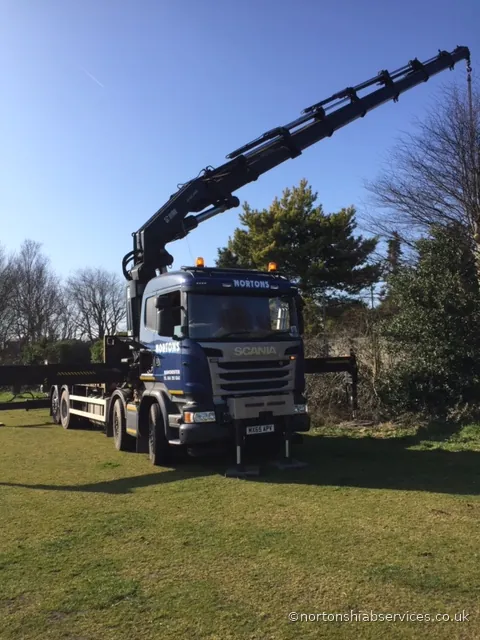
A cast sculpture onto a green
Delivered on the rigid, slung from the crane and walked over a boundary wall onto prepared ground. Click any of them to open it full size — arrow keys or a swipe move through the set.
What we need to know
- What it is made of and how it is finished. Painted, polished, patinated, cast, welded plate — it changes what may touch it.
- Where the lifting points are, if it has any. If the fabricator has built eyes into it, that decides the rig. If not, we work out how to sling it without them.
- Which way up it travels, and whether it can lie down. Some pieces cannot, and it is much better to know that before the lorry arrives.
- Where the vehicle can stand, and how far that is from the base. The distance from the centre of the crane to where it lands is the number that chooses the lorry.
- What the base is and how much tolerance it has. Dowels, a bolted plate and a bed of grout are all different lifts.
- Who else is on site, and who the public are. Barriers, pedestrian routes, a parking suspension or a road closure where it is needed.
Truck mounted crane hire · When the reach is the problem · Hiab and driver hire · Wide loads
Moving artwork, answered
Do you move statues and sculptures?
Regularly, and we install them as well as carry them. A sculpture is a one-off that somebody has spent months making, so it is treated as a lift to be planned rather than a load to be shifted. The vehicle brings its own crane, which means the piece is only handled twice: once onto the deck and once onto its base.
What makes a sculpture different from any other load?
Three things. It is irreplaceable, so there is no version of the day where you have another go. It is usually an awkward shape with the weight nowhere near the middle, so where the slings go matters more than what it weighs. And the finish is part of the work — a scuff on a painted or polished surface is damage in a way that a scuff on a steel beam is not.
How is a piece protected on the vehicle?
Soft slings and padding wherever webbing touches the piece, a spreader beam where a straight pull would squeeze it, timber and steel chocking built up round the base so it cannot move on the deck, and ratchet straps taken to that framework rather than over the artwork. Everything that touches it is chosen before the vehicle leaves the yard.
Can you install it as well as deliver it?
Yes, and that is usually the point of using a hiab. The lorry arrives with the piece on it, sets its legs, lifts it off its own bed and lands it on the plinth. There is no second vehicle to book and nothing standing about on hire. Where the client wants us to take responsibility for the lift itself we do it as a contract lift, with our own plan and our own appointed person.
What about installing in a public place?
Most of this work is in one — a town centre, a retail park, a park or a green. That makes pedestrian management, barriers and sometimes a road closure or a parking suspension part of the job rather than an afterthought. Tell us where it is going and we will tell you what the site needs and who has to be asked.
How far can the crane reach?
Up to 19.6 metres on our largest rigid, measured from the centre of the crane rather than from the back of the lorry. Reach matters more than weight on this work: a sculpture is often going into the middle of a paved area or a lawn that the vehicle cannot follow it onto. Tell us the distance from where the lorry can stand to where the piece has to land and we will tell you which vehicle gets there.
Can you store a piece before it is installed?
Yes. Fabrication finishes and site readiness rarely line up, and we have secure yard and covered storage in Manchester for exactly that gap. It is a great deal cheaper than a wasted delivery and a second collection.
More of this work: the 2017 portfolio · the 2019 portfolio · everything else
Tell us about the piece
What it is and where it has to end up. We will tell you how it should be rigged and what the site needs.