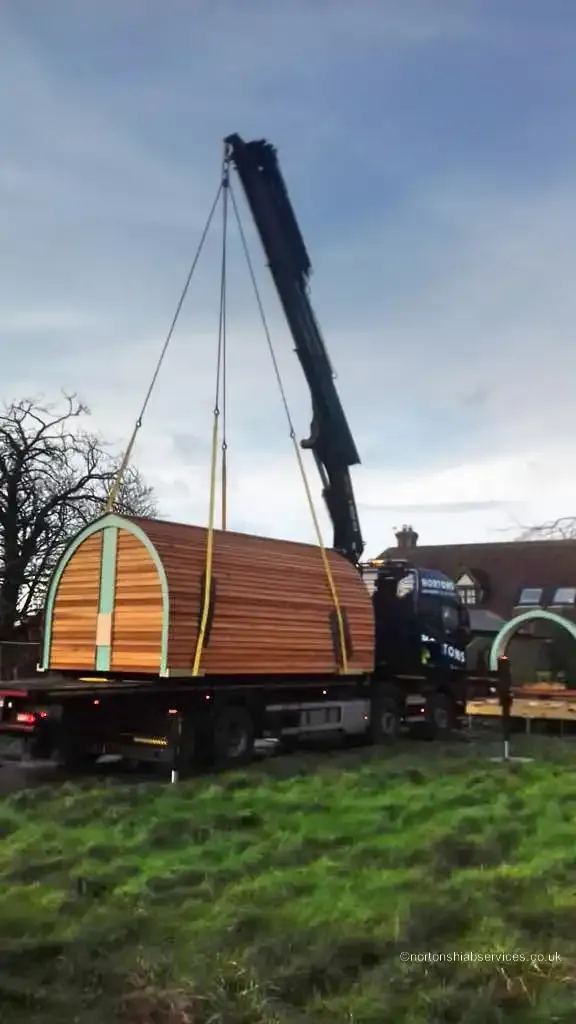
We do work off grass. We do it having thought about it first, and that is the whole of this article.
The numbers
Our 855 puts up to 220 kN through a single stabiliser leg — call it twenty-two tonnes through one point. The manufacturer's ground data tells you how much pad that needs on different ground:
- Compacted crushed stone: about 0.88 square metres. A 940 mm square pad.
- Asphalt or coarse sand and gravel: about 1.10 square metres, a 1,050 mm square.
- Firm cohesive ground or unconsolidated fill: about 2.20 square metres, a 1,484 mm square.
- Soft cohesive ground: about 5.50 square metres. That is a 2.35 metre square pad, under one leg.
- Mud, peat and marshy ground: nothing. There is no figure because the answer is no.
The spread between the best case and the workable worst case is a factor of six. It is not a detail.
What gets damaged, and what gets dangerous
Two different problems. Damage is block paving, resin drives, new tarmac in warm weather and lawns in wet weather. All of it is avoidable with enough pad and honest expectations, and all of it causes arguments when nobody mentioned it beforehand.
Danger is a void: a basement, a cellar light well, a drainage run, a soakaway, a service trench backfilled last month, an old coal chute under a pavement. These do not look different from the surface and they are the reason we ask.
What to tell us
What the surface is. Whether anything has been dug and refilled in the last year. Whether there is a cellar. Whether the drive is new. If you have a drainage drawing, that is better than anything you could say.
What we bring
Pads as standard, and bigger ones when the ground calls for it. If the ground genuinely will not take the machine, the answer is a different standing position or a different job — not a bigger pad and some optimism.
The ground bearing data in full · Lift planning · Pod deliveries