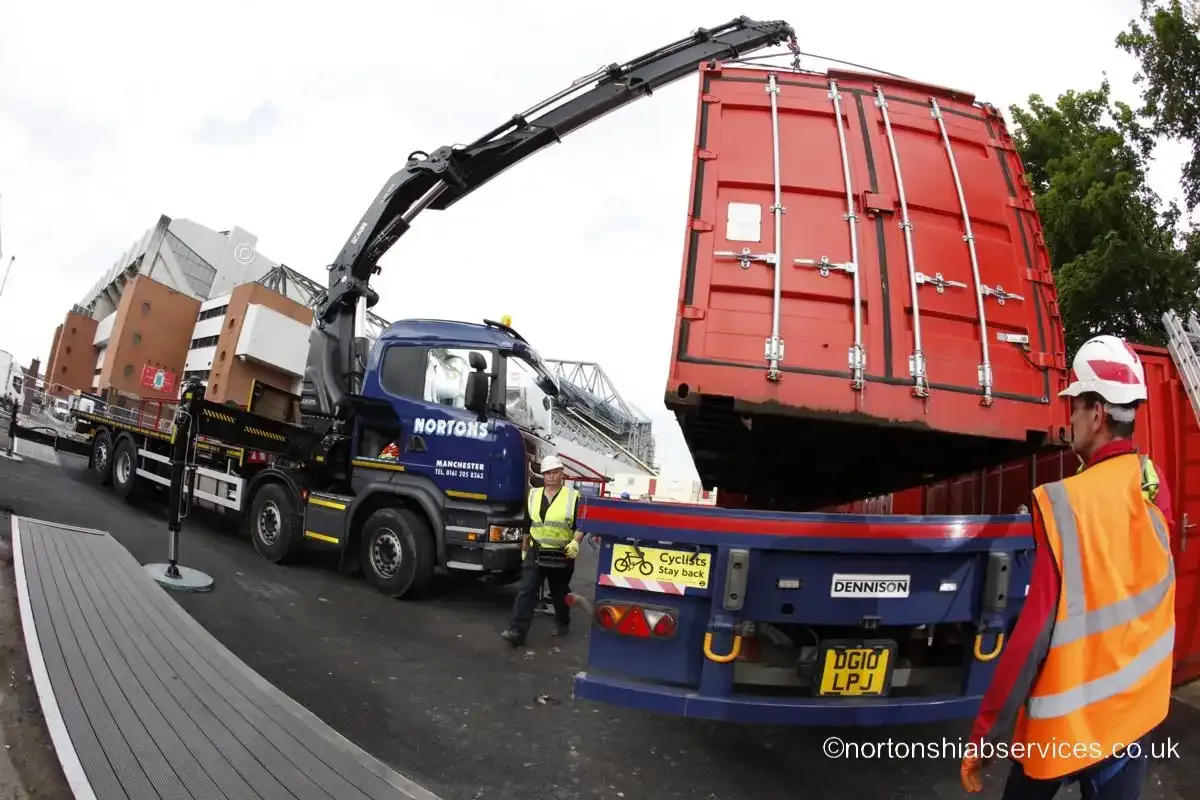
Site hoardings are solid for good reasons and they are exactly the wrong height — too tall to see over from a control station, too short to matter to a boom. Every compound job involves at least one lift where the operator is working entirely on what somebody else tells him.
What is set up before the first lift
Somebody walks the landing area and clears it. Not glances at it — walks it, because a pallet of blocks or a length of ducting that has appeared since the site visit is invisible from the road.
The banksman takes a position where he can see the landing point and the operator without moving, and that position is checked against where the boom will be, because standing under it is not an option.
The radio channel is agreed and tested. So are the hand signals, in case it is not.
Landing blind
The load comes down slowly and stops a foot above where it goes. Everything is checked at that point: is it square, is it in the right place, is anybody near it. Then the last foot, at a speed that looks almost comically slow to anybody watching.
That pause is not indecision. A container landed a hundred millimetres out on a compound is a container that will not stack, and lifting it again means unslinging, re-rigging, and doing the whole thing twice.
The Anfield version
At the stadium the hoarding ran the length of the compound with a public footway on our side of it. So the exclusion zone had to include pavement, which means cones, barriers and somebody whose whole job is asking people to wait fifteen seconds.
Most of them do. The ones who do not are the reason the zone is bigger than it looks like it needs to be.